120Water
Contact Us
Skip to content
English
  • There are no suggestions because the search field is empty.

School and Childcare Facilities: Sampling for Lead in Drinking Water

Your Facility. Your Water. Your Community.

AdobeStock_525510975 1

There is no safe level of lead exposure in children. Schools and childcare facilities are on the front lines, and testing your water is the first step toward knowing what’s in it. We’ve made that step simple. From sample kits to lab results, 120Water walks you through every part of the process so your community gets clear answers.

Did you know?

Beginning November 1, 2027, community water systems across the United States will provide lead education every year to the schools and childcare facilities they serve, and offer them lead testing. It's part of the U.S. Environmental Protection Agency's Lead and Copper Rule Improvements (LCRI), which strengthen protections for the places children spend their days.

Why it matters.

Children are still growing, and their bodies absorb lead more easily than adults’ do. Most childhood lead exposure comes from paint and dust in older buildings, not water. But water is still worth checking. You can’t see, smell, or taste lead, so testing is the clearest way to know.

Water leaving the treatment plant typically has very little or no lead. Lead gets in along the way, from service lines, solder, faucets, fountains, and fittings inside a building. Two buildings on the same street can have very different results, and so can two faucets in the same building. That’s why testing happens at the tap, inside your facility.
Health effects of lead, from the EPA

"There is no safe level of lead in drinking water. Exposure to lead in drinking water can cause serious health effects in all age groups, especially pregnant people, infants (both formula-fed and breastfed), and young children. Some of the health effects to infants and children include decreases in IQ and attention span. Lead exposure can also result in new or worsened learning and behavior problems. The children of persons who are exposed to lead before or during pregnancy may be at increased risk of these harmful health effects. Adults have increased risks of heart disease, high blood pressure, kidney or nervous system problems. Contact your health care provider for more information about your risks."

Source: U.S. EPA, Lead and Copper Rule Improvements (40 CFR 141.85)

Under this federal rule, elementary schools and childcare facilities are included in required lead testing, because young children face the greatest risk to their development. The requirement sits with your water system, and the testing happens inside your building, so your participation is what makes it work.

Elementary schools and childcares

Included in required lead testing. You'll receive a proposed sampling schedule and an invitation to take part.

Middle and high schools

Welcome to take part any time. Request testing through your water system whenever you're ready.

There's no cost to your facility. Kits, return shipping, lab analysis, and results are all provided. Already tested through a state or local program? Let your water system know, since your state may count it toward this program.

Ready to take part?

Look for the sign-up QR code or link in the letter or flyer from your water system. Each water system runs its own program, so sign-up happens through its materials. Can't find it? Contact your water system.

How it works

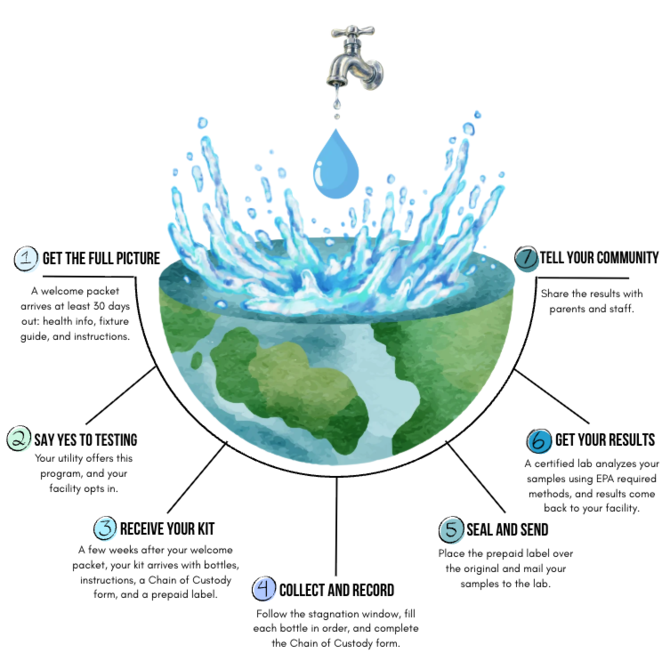
Here's what to expect, from saying yes to sharing your results.

Screenshot 2026-10-15 at 5.08.43 PM


1Get the full picture. A welcome packet arrives at least 30 days out, with health information, a fixture guide, and instructions.
2Say yes to testing. Your utility offers this program, and your facility opts in.
3Receive your kit. A few weeks after your welcome packet, your kit arrives with bottles, instructions, a Chain of Custody form, and a prepaid label.
4Collect and record. Follow the stagnation window, fill one bottle per tap, and complete the Chain of Custody form.
5Seal and send. Place the prepaid label over the original and mail your samples to the lab.
6Get your results. A certified lab analyzes your samples using EPA-required methods, and your results letter explains what they mean and any recommended next steps.
7Tell your community. Share the results with parents and staff.

How many samples.

Choose taps people actually drink from or use for food. Skip janitor sinks and outdoor spigots.

5 Samples for schools
2 from drinking water fountains
1 from a kitchen faucet used for drinking or cooking
1 from a classroom faucet or other tap used for drinking
1 from a nurse's office faucet, if available
2 Samples for childcares
1 from a drinking water fountain
1 from a kitchen faucet used for drinking or cooking, or a classroom faucet used for drinking

Tip: Missing a tap type? Sample another tap commonly used for drinking and note it on your Chain of Custody form. In-home childcare providers may only have a kitchen sink and a bathroom sink, and that's okay. Just note it on the form.

Before you sample

✓Water must sit unused for 8 to 18 hours. Collect first thing in the morning, before anyone arrives.
✓Use the very first cold water out of the tap. Don't run it first.
✓Tuesday through Friday mornings work best. Avoid Mondays and the first day back after a holiday or break.
✓Mail your kit back the same day if you can.

Good to know: Some states, tribes, and local agencies have their own lead testing rules for schools and childcares. Check with your state, tribal, or local agency to see what applies to you. This site covers the federal requirements and EPA recommendations.


For parents and families

Your child's school or childcare may be testing its drinking water for lead as part of a new federal program. It's a proactive step to help keep kids healthy. Results go to the facility, along with options to reduce lead if it's found. Ask your director if you'd like to see them.

Everyday habits that help, at school and at home:

✓Run cold water until the temperature shifts, then a few seconds more, before drinking or cooking
✓Use only cold water for drinking, cooking, and baby formula
✓Clean faucet aerators every few months
✓If you use a filter, choose one certified to reduce lead and replace it on schedule

Questions about your child's health? Talk with your health care provider about a blood lead test.

Still have questions? We've got answers. Explore our FAQs and Knowledge Center.